Showing posts with label oceanography. Show all posts
Showing posts with label oceanography. Show all posts
Tuesday, July 9, 2013
Ancient Forest Found Underwater

Monday, August 27, 2012
EPB Virtually Impassable

Thursday, January 5, 2012
New Species around Sea Vents

Sunday, November 6, 2011
Bacteria Affecting Climate

Tuesday, October 18, 2011
New Life in Dead Sea

Tuesday, October 4, 2011
"Missing Heat" in Oceans

Friday, June 17, 2011
Underwater "River" Discovered

Saturday, May 7, 2011
Noise Pollution in Oceans

Saturday, April 17, 2010
Undersea Superhighway Found

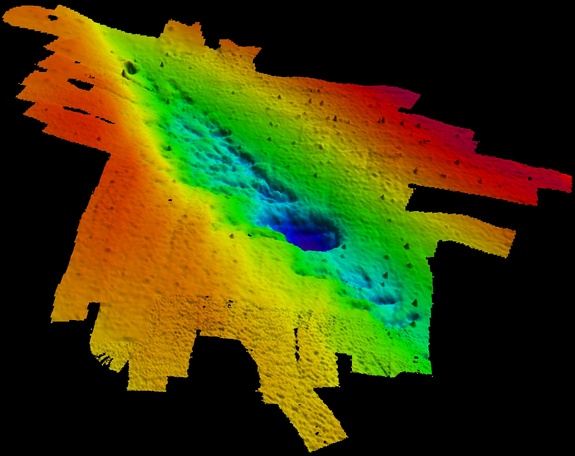
Scientists have discovered an undersea "superhighway" amid a complex of newly disturbed hydrothermal vents responsible for repopulating an area after a recent eruption with tiny life forms from as much as 300 km away.
Tuesday, March 31, 2009
New Theory of Extinction
 A new theory of the Permian/Triassic extinction 250 million years ago suggests that halogenated gases resulting from giant salt lakes altered the atmosphere enough to affect land-based vegetation.
Tuesday, March 3, 2009
Unusual Life Found in American Great Lakes
 Scientists at Grand Valley State University have discovered some unusual species in the waters of Lake Huron, life forms more suited to extreme environments than freshwater lakes.
In underwater sinkholes 66 feet below the surface made by dissolving parts of an underlying seabed exist large purple mats of cyanobacteria and streamers of other microbial life living in massive physical colonies. The water in these sinkholes is oxygen-free and salty, similar to unfriendlier environments such as hydrothermal vents or the bottom of permanently frozen lakebeds in Antarctica. Such water composition is hostile to most forms of marine life.
These sinkholes act as basins to catch dead and decaying plant and animal matter, providing a microenvironment for life such as cyanobacteria to thrive. In this environment, microorganisms use chemical means rather than photosynthesis to break down sulfur compounds for food.
These results were published in a recent edition of Eos.
Source: LiveScience
Saturday, January 24, 2009
New Marine Animals Discovered in Tasmanian Ocean
 A joint US-Australian team of scientists from the California Institute of Technology and the Commonwealth Scientific and Industrial Research Organisation (CSIRO) has discovered previously unknown species of marine animals while exploring the deep waters off the coast of Tasmania.
The new animals found include "a bizarre carnivorous sea squirt [ascidian], sea spiders and giant sponges, and previously unknown marine communities dominated by gooseneck barnacles and millions of round, purple-spotted sea anemones." The team also found vast fossil coral fields dating back more than 10,000 years, from which samples could reveal ancient climate data.
The team used a submersible robot named Jason to venture into a previously unexplored area known as the Tasman Fracture Zone. This zone is a rift in the Earth's crust that drops a sheer two kilometers to end at 4000 meters below the ocean's surface and is part of a protected marine reserve. The team also found evidence of the coral reef system dying, possibly as a result of the warming of ocean temperatures.
These results were published recently by the CSIRO Wealth from Oceans Flagship.
Source: ScienceDaily; Photo: Yahoo!
Subscribe to:
Posts (Atom)

