Wednesday, July 10, 2013

Optical Lattice Atomic Clock

Scientists have developed a new method of timekeeping called an optical lattice atomic clock that is three times more accurate than current atomic clocks, measuring oscillations from strontium atoms excited by a laser rather than microwave-based cesium fountains with an accuracy of losing only one second every 300 million years.

Tuesday, July 9, 2013

Ancient Forest Found Underwater
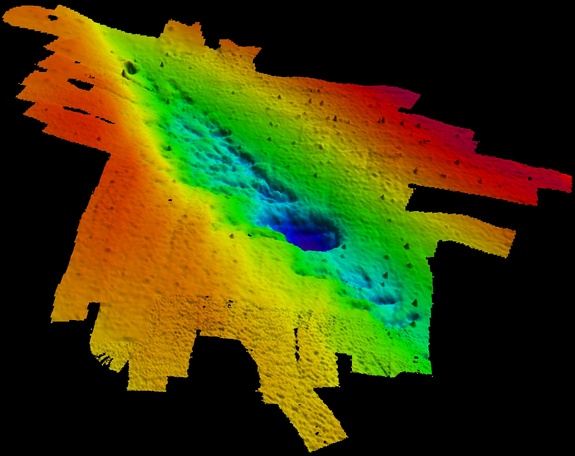
Divers have discovered a Bald Cypress forest at least 0.8 km long off the coast of Alabama, freshly preserved for at least 52,000 years under ocean sediment in an oxygen-free environment in the Gulf of Mexico and most likely uncovered by Hurricane Katrina in 2005.

Monday, July 8, 2013

Mysterious Deep-Space Explosions

Astronomers from the CSIRO Parkes radio telescope have detected four point sources of powerful fast radio bursts (FRB) of unknown origin outside the Milky Way galaxy and billions of light-years away, each lasting only a few milliseconds yet giving off more energy than does our Sun in 300,000 years.

Tuesday, July 2, 2013

Pluto's Moons Named

After a membership vote, the International Astronomical Union (IAU) has formally adopted the names Kerberos and Styx for the recently discovered fourth (P4) and fifth (P5) moons, respectively, of Pluto.

Saturday, June 29, 2013

Meteor Shockwave Circled Globe

The shockwave from a 17-m, 10,000-ton meteor that burned up over Chelyabinsk, Russia, in February was powerful enough to circle the Earth twice, as measured by an International Monitoring System designed to detect ultra-low frequency acoustic waves (infrasound) from nuclear tests.

Wednesday, June 26, 2013

New Bird Species in Metro Area

The Cambodian tailorbird (Orthotomus chaktomuk), a species new to science, was found in the capitol city Phnom Penh during routine checks for the avian flu in 2009, the first time a new animal species has been discovered in a modern urban environment.

Saturday, June 22, 2013

Fruits, Vegetables Still Alive

New research shows that fruits and vegetables can respond to circadian cycles up to about a week after harvest, adapting their internal levels of nutrients and protective chemical compounds in response to predator cycles.

Friday, June 21, 2013

Tetraquark Candidate Found

Researchers at KEK's Belle Collaboration and Beijing's BESIII Collaboration have independently reported evidence for a tetraquark particle designated Zc(3900), the strongest evidence yet for matter consisting of more than three quarks.

Thursday, June 20, 2013

Lost Mayan City Discovered

Archaeologists have discovered the lost Mayan city of Chactun hidden in the thick jungle of the Yucatan, a 22-hectare site that includes 15 pyramids and ball game courts and may have been home to as many as 40,000 people before being abandoned around 1000 A.D.

Wednesday, June 19, 2013

New Atlantic Subduction Zone

A newly formed crack in the Eurasian tectonic plate about 200 km off the southwestern coast of Portugal is the birth of a new subduction zone, splitting the plate into oceanic and continental sections that will cause the Atlantic Ocean to disappear in about 220 million years as Europe and North American drift toward one another.

Tuesday, June 18, 2013

Lost Cambodian City Revealed

Using LIDAR technology on board a helicopter, archaeologists have revealed the lost city of Mahendraparvata in Cambodia, a planned urban network of roadways and canals linking the 1200-year-old temples of the Angkor Wat complex hidden under dense vegetation.

Friday, June 14, 2013

New Layer of Cornea Discovered

Researchers have found a previously unknown and distinct tough sixth layer (named the Dua's layer after its discoverer) in the cornea of the human eye, located at the back of the cornea with a thickness of only about 15 microns.

Thursday, June 13, 2013

Fossil Soft Tissue Reconstructed

Scientists have reconstructed the neck and abdominal muscles of rare, well-preserved 380 million-year-old early jawed fish (placoderm) fossils from the Gogo Formation of northwestern Australia using high-contrast x-ray beams to image the soft-tissue impressions without damage to the fossil.

Wednesday, June 12, 2013

Cheetahs Faster than Ferraris

Using lightweight, solar-powered collars with GPS and intertial-measurement devices, scientists found surprising results of the movements of cheetahs in the wild where, instead of record top speeds, the animals displayed agility and acceleration greater than high-performance sports cars and energy absorption when stopping three times greater than polo horses.