Sunday, May 30, 2010

New African Pterosaur

A new and rare African pterosaur species (Alanqa saharicafrom) has been discovered in Morroco and likely flew only rarely, preferring instead to stalk prey on the grounds of what was once the lush wetland of the Sahara.

Saturday, May 29, 2010

Scramjet Hypersonic Flight

An unmanned X-51 Waverider test vehicle successfully made the longest flight yet (200 seconds) with the new Pratt & Whitney scramjet engine, reaching a speed of Mach 5 in the first of four planned tests of the new technology.

Friday, May 28, 2010

Mystery Fossil Is Squid

After a new study, paleontologists have determined a previously "unclassifiable" fossil to be a two-tentacled ancestor of the squid family (Nectocaris pteryx), revealing these cephalopods lived 30 million years eariler than previously believed.

Thursday, May 27, 2010

Planets with Crossing Orbits

Astronomers have discovered that two of the three Jupiter-like planets known to orbit the star Upsilon Andromedae have orbits that are tilted 30 degrees from each other, the first time a stable non-coplanar planetary system has been observed.

Wednesday, May 26, 2010

New Handfish Species

With only four specimens having ever been found in the waters off of Tansmania, the pink handfish has been formally identified as a new and distinct species of the handfish family, creatures who use their fins to walk along the ocean floor.

Tuesday, May 25, 2010

Sun Enters Interstellar Cloud

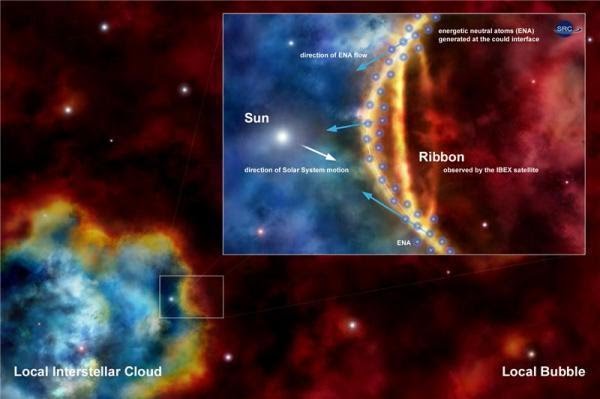
Using data gathered by NASA's IBEX satellite, researchers propose that as early as next century the Sun and its planets will cross a boundary into a relatively hot and turbulent interstellar gas cloud, possibly the remnants of an ancient supernova.

Monday, May 24, 2010

Planet-Eating Star


The Hubble Space Telescope has captured evidence of a star "eating" one of its orbiting planets (Wasp-12b), with the planet's atmosphere ballooning due to its proximity and a cloud of material escaping and captured by the nearby dwarf star.

Sunday, May 23, 2010

Copernicus Reburied

After positively identifying remains found in an unmarked grave beneath a church in a small seaside town in Poland in 2005, the founder of the heliocentric theory Nicolaus Copernicus was laid to rest in a Roman Catholic funeral more than 500 years after his death.

Saturday, May 22, 2010

Books in Home, Education

A 20-year study reveals that children raised in a home with a 500-book library can advance their educational level by as much as 3.2 years, regardless of any other demographic indicator of achievement such as the parent's education, occupation, economic success or nationality.

Friday, May 21, 2010

Synthetic Cell Created

Scientists have synthesized an entirely artificial genome and replicated it by inserting it into a live bacterium, taking one step closer to creating artificial or laboratory-designed life.

Thursday, May 20, 2010

Matter/Antimatter Asymmetry

Experiments at Fermilab have demonstrated a 1% difference favoring the production of pairs of muons over antimuons in B-meson decay, indicating a natural bias toward matter over antimatter that may lead to explaining why we live in a matter-dominated universe.

Wednesday, May 19, 2010

Oldest Mesoamerican Tomb

A 2700-year-old tomb of a dignitary has been uncovered in southern Mexico beneath a pyramid, making it the oldest such burial yet discovered in Mesoamerica.

Tuesday, May 18, 2010

Kirchhoff's Law Redefined

Researchers at the University of Illinois have added an optical laser component to the semiconductor setup measuring charge input and output, forcing a redefinition of the longstanding Kirchhoff's law of electrical current.

Monday, May 17, 2010

Cell Phone Sensor Network

Researchers have developed a chemically sensitive silicon chip small enough to be embedded in current commercial cell phones, using the ubiquity of the personal devices and their networks to provide real-time data in cases of chemical accidents or attacks.