Friday, October 8, 2010

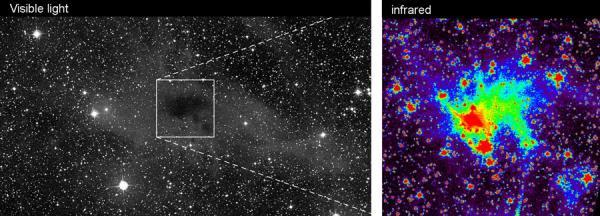
"Coreshine" and Star Birth

Astronomers have coined the term "coreshine" to describe the newly discovered phenomenon of mid-infrared light scattered by the interior of stellar clouds of dust and gas, providing a method to see inside developing stars that are otherwise opaque to visual examination.

Thursday, October 7, 2010

California Animal Fossils

Workers digging a trench for a California utility company southeast of Los Angeles have unearthed a rich trove of 1500 fragments of animal and plant fossils including some 35 species dating back some 1.4 million years, filling in some gaps in the area's natural history.

Wednesday, October 6, 2010

Massive Blast Created Phobos

Astronomers have uncovered firm evidence, namely the presence of minerals that only form in liquid water, that Mars' largest moon Phobos owes its origin to a massive collision of an object with the planet's surface.

Tuesday, October 5, 2010

Replace BIOS with UEFI

Having long outlasted its design lifespan, the legacy software for personal computers known as BIOS used to initialize and boot the individual systems will be replaced in 2011 with a more powerful and flexible Unified Extensible Firmware Interface (UEFI), which should allow computers to boot in seconds.

Monday, October 4, 2010

Swarm of Saudi Earthquakes

With more than 30,000 earthquakes recorded between April and June 2009 in the northwest corner of Saudi Arabia, an ancient lava field known as Harrat Lunayyir, this area is shown to be unexpectedly volcanically active.

Sunday, October 3, 2010

Bizarre Horned Dinosaur

Two new species of bizarre horned dinosaurs, relatives of the more well-known Triceratops, have been discovered in Utah as part of the lost continent of Laramidia during the Late Cretaceous that have an ornate configuration of up to 15 horns protruding from their face.

Saturday, October 2, 2010

600,000 Plant Species Cut

About 600,000 duplicate and erroneous plant species names are being eliminated in an effort to consolidate and develop a single inventory of the global plant species, ultimately with the goal of streamlining conservation and research efforts.

Friday, October 1, 2010

Tigers Found in Himalayas

A "lost" isolated population of tigers has been discovered and captured on video in the mountainous Himalayan foothills of Bhutan, living and successfully breeding at elevations higher than any other tiger species.

Thursday, September 30, 2010

Longest Life-Cycle

Researchers looking for cold-loving microbes on the Norwegian coastal sea floor discovered a dormant species of bacteria that only germinated at temperatures above 50 C, making them the organism with the longest life-cycle as they lay in the freezing Arctic sediment for 100 million years.

Wednesday, September 29, 2010

Human-Sized T. Rex

Recently discovered fossil specimens of early Tyrannosaurus species (including six last year alone) show that the giant Cretaceous predator was no larger than a human throughout most of its evolution, reaching its dominant size and ecological position only about 80 million years ago.

Tuesday, September 28, 2010

Moon's Geologic Complexity

Data returned from NASA's Lunar Reconnaissance Orbiter (LRO) shows a level of previously unseen compositional differences in the lunar crust from high-resolution infrared maps, revealing a more complex geological makeup than ever believed.

Monday, September 27, 2010

Columbus' Crew DNA

A new study of DNA taken from a graveyard in La Isabela, Dominican Republic, reveals that Africans crossed to the New World more than 150 years earlier than previously thought, with at least two Africans serving among the crew of Columbus' second voyage there in 1494 when the site was first settled.

Sunday, September 26, 2010

Glucose Biofuel Cell

An implantable biofuel cell has been successfully test in a rat, drawing its power supply from the natural glucose and oxygen available in the body and producing a significant amount of electrical energy while the subject suffers no ill effects.

Saturday, September 25, 2010

Giant Fossil Bird Found

An "exceptionally preserved" fossil skeleton more than 70% complete of a giant toothed bird (Pelagornis chilensis) has been found in Chile, with its 17-foot wingspan making it one of the largest flying birds to have ever lived.